Translate to multiple languages

Subscribe to my Email updates

https://feedburner.google.com/fb/a/mailverify?uri=helgeScherlundelearning
Enjoy what you've read, make sure you subscribe to my Email Updates

Thursday, March 05, 2015

Technology Is Transforming What and How We Learn

Follow on Twitter as @DanielBurrus
"In today's world of technology-driven transformational change, it's important to understand that "[i]f you received a Ph.D. ten years ago, it only means you used to know a lot."" according to Daniel Burrus, Keynote Speaker, Business Strategist and Global Futurist.

Photo: The Huffington Post

It's not just what you learned but, more importantly, that you learned how to learn and keep learning, because things change so rapidly, and knowledge, even the most specialized kind, can get out-of-date very quickly. Given the accelerating pace of change, one has to ask: Does investing time and money in education still have the same payoff it once did? Does the particular expertise you acquire remain relevant and put you at an advantage in the real world? Or have you lost a step and several years on your way to attaining an impractical degree? I don't intend to diminish anyone's education, but these are questions worth considering.

I want to make a distinction between degrees and education. There have been recent news articles that suggest that degrees may not be as important as they used to be. Rather than debate the degree issue, I would rather focus our attention on the fact that education itself -- the ongoing process of discovery -- is absolutely essential. Becoming an expert in a field of study is and will continue to be important only if you keep learning. Therefore becoming an expert at learning is invaluable.

What we need now is not "knowledge" in the sense of some static commodity that you can go out and acquire once and store up in a vault for later use. Instead, we need a perpetual state of learning, of taking in all the new information that's coming our way, and using it to increase our understanding, which allows us to drive innovation.

In other words, the most valuable kind of learning you can do is to learn how to adapt and innovate, not to memorize but to contribute, not to consume but to create. It's likely that as we go forward, traditional degree programs will refocus themselves and perhaps emerge as something else entirely.
Read more...

Source: The Huffington Post

Learning Music Improves Communication Skills Says Study

"Research suggests strong connection between learning an instrument and learning to talk, listen and read" carried out by Northwestern University.
 
Photo: antiMUSIC.com

A scientific study has suggested there's a strong link between children learning to play a musical instrument and developing better communication skills.
 
The research implies that a musical education could be more valuable to educational development than many authorities believe.

The study was carried out by Northwestern University, who took high school students from Chicago and placed half in a standard course, and the rest in a musical training programme.
 
The results indicate that those who were taught to play music showed faster response times when it came to interpreting speech – and also showed improved reading ability.
Read more...

Source: antiMUSIC.com

Wednesday, March 04, 2015

Denmark: International students – A good investment


University World News writes, "Foreign students contribute more to Denmark in financial terms than they cost to complete their higher education degrees, a study has found."
 

The study, by a Danish think-tank on the socio-economic impact of international students, found that they contributed more than $US24 million to the economy in the 12 years to 2008, even after deducting the costs it took to educate them in Denmark.
 
A report of the study says that the increasing recruitment of international students had led to fears that the cost of funding public higher education would rise.
 

But the study authors say that as long as Danish businesses and industry hire sufficient numbers of international students after they complete their education, and they remain in Denmark for several years, the overall economic benefit will be greater than the cost of educating them.
 

In the 12 years to 2008, nearly 9,000 international students enrolled in Danish higher education institutions. Almost 6,000 students completed their courses while 3,000 either dropped out or were exchange students, not there to undertake a full higher education course.
Read more...

 Source: University World News 

BYU-Idaho Supports Online Learning with Automated Video Transcoding

Leila Meyer, technology writer summarizes, "Brigham Young University-Idaho has automated the process of converting videos created by professors into formats required for online viewing, and the system has processed more than 13,000 video assets in the last year and a half."

Photo: Campus Technology

Online Learning Strains Video Production Capabilities
BYU-Idaho currently offers four online associate degrees, 10 online bachelor's degrees and more than 100 online courses, and it's working to expand its online course offerings. Some faculty members are also using video-based tutorials, lectures and course materials to augment traditional face-to-face classes, and the campus is home to a large broadcasting facility. Professors create their own videos and send them to the university's in-house video production facility to be converted to the required format for online viewing, and the large volume of videos was straining the capabilities of the facility.

"It was becoming very apparent that the number of videos we were creating was just going to skyrocket, both for content for academic use and content for production use," said Michael Jeffs, media support specialist in the A/V Production and Broadcast department at the university.

Jeffs and the team at the video production facility began searching for a transcoding system that could easily convert large numbers of faculty-recorded videos to a format for distribution and viewing on a variety of device types.
Read more...

Source: Campus Technology  

Blended learning format mixes traditional, online learning

"During his Tuesday afternoon Math 134 class, Grand Canyon University professor Dr. Filippo Posta lectures on algebra and calculus to more than 80 freshmen and sophomores. Many of the concepts he covers are refreshers from high school classes." according to Cooper Nelson, News and Events of Grand Canyon University.

Photo: GCU professor Filippo Posta lectures to students during the Tuesday “ground” day of his spring Math 134 class. Posta led the first blended learning class at GCU last summer. (Photo by Darryl Webb)


On Thursday, a fraction of the students attend class, trickling in late and staying for a half-hour at most. Many spend time doing homework on laptops. But Posta doesn’t seem to mind. He floats around the room, answering questions.

Posta’s class is among several traditional undergraduate classes that are part of a new blended learning format that GCU, as it explores ways to combine elements of traditional and online courses, piloted this year. In the format, students meet for ground classes once or twice a week and complete homework assignments online, using the extra class day for tutoring or study time. Other blended courses include Psychology 102, Physics 111, Biology 220 and Biology 483.

Through the College of Humanities and Social Sciences, the blended learning concept was first introduced over the summer in Posta’s Math 110 course as a way to reinvent 100-level classes to be more engaging and valuable as core degree courses. GCU is a leader in online education with more than 55,000 students and 200 online full-time faculty members and also has a burgeoning traditional enrollment of nearly 11,000.

Provost Dr. Hank Radda said the blended program may not apply to every class. But the University hopes to use the concept to improve the quality of general education courses and provide students a greater depth of online learning.

“We’re always trying to do our best to improve learning and learning outcomes for our students,” Radda said. “We have experienced teachers who have a willingness to explore blended learning and a desire to improve the pedagogical experience and make learning better for students. GCU is the perfect playground because it is essentially already a blended university, being a pioneer with online and ground.”
Read more...

Source: GCU Today - News and Events of Grand Canyon University.

Open Education Handbook Overview

The Open Education Handbook is a collaboratively written living web document targeting educational practitioners and the education community at large.

The Open Education Handbook

Open Education is a topic which has become increasingly popular in a variety of contexts. The Open Education Handbook has been written to provide a useful point of reference for readers with a range of different roles and interests who are interested in learning more about the concept of Open Education and to help them deal with a variety of practical situations. 

As a “living” online document, we hope that it will continue to evolve, reflecting cutting edge research and innovation in this area and helping educational communities to come to an improved understanding of the value of open. 

The Open Education Handbook is a community project of the Open Education Working Group.

Additional resources

Talk given at Open Knowledge Community session, 11th December 2014

Tuesday, March 03, 2015

Philadelphia Orchestra holds Collaborative Learning Week

Photo: Allie Volpe
"It’s all about teamwork this week with the Philadelphia Orchestra" reports Allie Volpe, philly.com.

Photo: Double bassist Joseph Conyers (right) works with members of the bass section of the All City Music orchestra during a rehearsal. His organization, Project 440, will take over running the School District program. ( ED HILLE / staff hotographer ) Ed Hille

With a week full of events that will see the famed orchestra partnering with various local groups, music appreciators of all ages will find classical entertainment to enjoy.

Hundreds of students from over 30 Philadelphia high schools will play in Monday, March 2’s All-City Music Festival, featuring the All-City Choir, Band and Orchestra. Beginning at 7:30 p.m. at the Kimmel Center (Broad and Spruce Streets), the free concert will see Maestro Yannick Nézet-Séguin serving guest conductor duties for the finale.

Students will get the chance to see the Philadelphia Orchestra in action before they hit the stage for the big show on Thursday, March 5. At 10:30 a.m., over 700 students will sit in on an open rehearsal at the Kimmel Center (Broad and Spruce Streets) before that evening’s 8 p.m. Beethoven Piano Concerto No. 3. featuring pianist Emanuel Ax. Before the show, however, at 6 p.m. amateur cellists can get the chance to play with the Philadelphia Orchestra. Register ahead of time, though, or just come to watch the community take part in a free arts event.

The Philadelphia Orchestra collaborates on Saturday, March 7 with the Philadelphia Youth Orchestra when Yannick Nézet-Séguin will lead a rehearsal at 10 a.m. at the Kimmel Center (Broad and Spruce Streets), where the young musicians will get pointers and tips from the pros.

Source: philly.com

MathType 6.9: enable handwritten math in 800+ applications & websites

Handwrite math in 800+ applications & websites
 
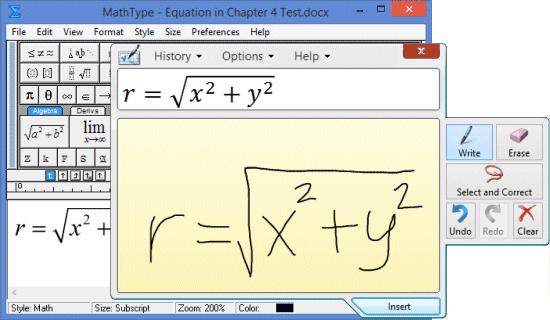
MathType 6.9 takes full advantage of the Windows Math Input Panel (available in Windows 7 and later,) which provides support for handwritten math recognition. With MathType and the Math Input Panel you can easily write out your equations and insert them into 800+ applications and websites.


Mouse, tablet, or pen
Although you can handwrite equations using only a mouse, for best results we recommend using a tablet or a pen device.


Opens within Microsoft Word
MathType 6.9 adds a button to Microsoft Word's ribbon, and a menu command to MathType. Each brings up the Math Input Panel ready for handwriting equations.


Build large equations from small handwritten expressions
While entering math by hand using the Math Input Panel is easy for simple expressions, MathType's editing comes in handy for combining simple expressions to make larger ones or when correcting mistakes. Math Input Panel together with MathType gives you the best of both worlds.


We're listening
You can download a 30-day full version of MathType and try MathType with handwritten math and the other new features for free. When you do, we would love to hear what you think. Send us an email or talk with us on
Facebook, Twitter, or YouTube!


buy now Purchase MathType directly from our secure online store.
More Information Read about all of the new MathType features.
30-day trial Try the full version of MathType before you buy! 

Source: Design Science

Monday, March 02, 2015

Cédric Villani: ‘Mathematics is about progress and adventure and emotion’

Carole Cadwalladr, features writer for the Observer discovers that fields medal winner Cédric Villani is an impassioned advocate for mathematics.

French mathematician Cedric Villani. 'You have to have an intense interior life.' Photograph: Joel Saget/AFP/Getty Images

The second time I meet Cédric Villani is when I bump into him in the Eurostar terminal in Paris. But then how could I miss him? There are crowds of milling businessmen and weekending couples but there, amid the Sunday-night chaos of the Gare du Nord, is a figure who looks like he’s somehow slipped the space-time continuum: Lord Byron on a mini break. Or Baudelaire who has returned to Earth, only this time as a Parisian banker doing the Monday-Friday commute. He has a silk bow around his neck. His hair flows around his shoulders. And when I stop to say hello, he embraces me and starts telling me about his latest projects (dozens of them) and his trips (to everywhere, he’s always travelling) and the book he’s writing and then he rummages through his briefcase to give me a business card.
 
But instead of one business card, he hands me a stack of around 50, scattering another 50 or so over the floor. “Here! Take them!” he says. But, Cédric, I say, I only need one, but he presses them into my hands and as he does so drops a file of papers and a small case on the ground. The commuters and weekenders have, by now, started to take notice of the commotion in front of them, though he’s oblivious as he gesticulates and exclaims and then opens up the small case to show me what’s inside. “Spiders!” he says showing me a dozen different decorated hand-made spider brooches. “I always wear one,” he says and points to his jacket, where there is an ornate bejewelled spider crawling across his lapel.
 
As meetings with Cédric Villani go, this is not untypical. He looks like he’s just wandered in from the 19th century, speaks English with an accent that rivals that of Hercule Poirot, and has the physical dexterity of Manuel from Fawlty Towers, but he also happens to be one of the greatest mathematicians alive, a winner of the Fields medal, mathematics’ answer to the Nobel prize, handed out every four years.

I’ve met him three times by the time I read his new book, the one he was writing when I met him at the Eurostar terminal, Birth of a Theorem: A Mathematical Adventure. He’s spoken at two TEDxObserver events we’ve held and I’ve got to watch him close-up in action, both before and after the event. Both times, he delivered brilliant, arm-flailing, passionate expositions of the beauty of mathematics and why it matters. But what really marked him out of the norm wasn’t that, or the spiders and neckerchiefs: it was his intense engagement with the world around him. He was the only speaker who listened – intently – to almost half of the other talks. And afterwards, he talked – delightedly – to random well-wishers and stray journalists and the idly curious. To anyone and everyone. He takes on all comers, equally, with an openness and interest that is vanishingly rare in public life.

But it’s not until I read his book, an odd, fascinating account that attempts to render the mystery of the moment of mathematical revelation into a narrative a layperson can understand (you know, -ish, up to a point), that I realise that this isn’t despite his mathematical brilliance; it’s actually the cornerstone of it. The theorem – a new proof that explains Landau damping, a mysterious and complex property of plasma behaviour – was the result of a collaboration with a former student, Clément Mouhot, and he presents their emails to show how they bounced ideas back and forth. And that’s the least of it: there are conferences, seminars, encounters with random academics. Even his children, or “lambikins” as he refers to them at one point, play a part in his thinking and it’s not all that much of a surprise that when I try to catch up with him, I discover he’s in Senegal, and by the time I pin him down on Skype, he’s in Cameroon. 
Read more... 

TEDxObserver - Cédric Villani


Additional resources

What goes on inside the mind of a rock-star mathematician?
Where does inspiration come from? 
http://bookshop.theguardian.com/catalog/product/view/id/279419/


Birth of a Theorem: A Mathematical Adventure by Cédric Villani – review 
Cédric Villani (From Wikipedia, the free encyclopedia) 

Source: The Guardian and TEDx Talks Channel (YouTube)

Music makes us whole

Tara Bitzan, editor of the Echo Press summarizes,  "Initiative brings awareness to importance of music education."

Andrew Storm plays his tenor saxophone at Alexandria Area High School. Storm believes that music "teaches a lot of life lessons." (Tara Bitzan | Echo Press)

Can musical training improve an ACT score?
Can musical knowledge help a person be a better problem solver?
Can a musical background help someone make more money in a future job?

According to members of the Minnesota Music Educators Association (MMEA), the answer to all of the above is yes!


MMEA and Classical Minnesota Public Radio (MPR) believe that the benefits of music learning extend far beyond the classroom.

The two organizations are co-leading the Music Makes Us Whole initiative, which involves performing arts organizations, after school youth music groups, community music groups, music retailers and music educators.

Those involved believe that every child deserves a rich music education because of the whole-brain, whole-life benefits it provides.

While Minnesota schools have been adding teachers since 2006, the trend in music is the opposite – a decline, according to the latest data from the Minnesota Department of Education. That means larger, fewer or less frequent music classes.

“We advocate for quality music in schools not only because of the music’s intrinsic value in the human experience, but also for the whole brain and whole life benefits to the child, as well as his or her community,” said Brian Newhouse, managing director of MPR classical programming and member of the Music Makes Us Whole initiative.

DID YOU KNOW?
• Music training stimulates every region of the brain.
• Students with one or more year of high school music experience earn higher ACT scores – 4 percent in math and 7 percent in English.
• Low income students who took music lessons in grades 8-12 saw math, reading, history, geography and social skills soar by 40 percent compared to non music students.
• Reports from the National Endowment of the Arts found that at-risk youth with access to school arts programs also have higher career goals and are more civically engaged.
• Music students gain skills sought out by employers, such as teamwork, communication and problem solving.
• 83 percent of adults with incomes higher than $150,000 participated in music as youths.
Read more...

Related link
For more information, visit the website www.musicmakesuswhole.or

Source: Alexandria Echo Press