Translate to multiple languages

Subscribe to my Email updates

https://feedburner.google.com/fb/a/mailverify?uri=helgeScherlundelearning
Enjoy what you've read, make sure you subscribe to my Email Updates

Sunday, November 24, 2019

In the Jersey Suburbs, a Bookstore Whose Vibe Is Pure Narnia | Books Territory - The New York Times

Montclair Book Center is 9,000 square feet of nooks, alcoves, labyrinths and warrens. “It’s like a time machine,” one customer says, according to Dana Jennings, The New York Times.

Co-managers Maureen Disimile and John D. Ynsua at Montclair Book Center in New Jersey.
Photo: Bryan Anselm for The New York Times
Montclair Book Center is 35 years old, going on eternity.

A ramshackle throwback to a funkier, more literary time, the store has shelves handmade from raw lumber. And its customers and clerks are often just as eccentric as the shelves.

I’ve been shopping and snooping there since 1995 and still haven’t exhausted all of this biblioscape’s labyrinths and warrens — some of which, I suspect, lead to C.S. Lewis’s Narnia or Mervyn Peake’s Gormenghast.

Stuffed with hundreds of thousands of best sellers, worst sellers and everything in between, the store is a haven where you can ferret out that certain book (or vinyl record) you don’t know you need until you see it. I’ve stumbled across Italo Calvino limited editions, a hardcover of William Burroughs’s “Naked Lunch,” and a stash of musty, black-and-white comics magazines from the 1960s and ’70s that included Eerie, Creepy and Savage Tales.

The store, which sells both new and used books, is three floors and 9,000 square feet of nooks, alcoves and cul de sacs. Wooden floorboards creak and groan, and the owners have preserved the tin ceilings from the building’s decades as a hardware store...

John D. Ynsua, a co-manager and owner, says the store has hundreds of regulars, including many “who come from far away.” But some are more memorable than others. There’s the customer, for example, who anchors himself at the checkout and mutters in what sounds like heavy-metal vomit vocals. On one visit, he’ll ask for the Christian Bible; on others, the Satanic Bible.

More often, customers are like Fabrice Nozier, a senior at Drew University in Madison, N.J. “I like the feel of this place,” he said as he sat on the floor and pored over filmmaking volumes. “It’s like a time machine, coming here.”
Source: The New York Times

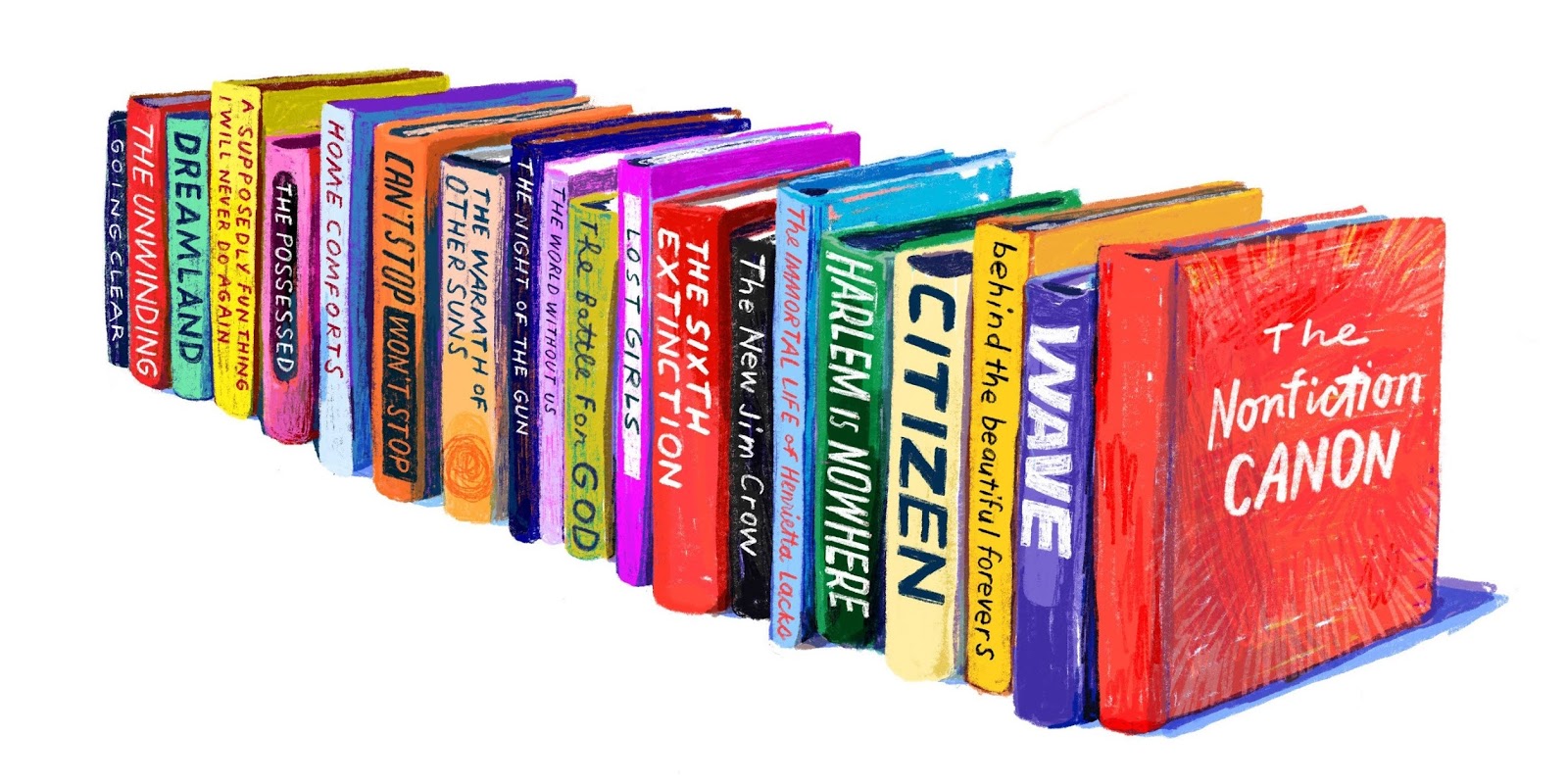
The 50 Best Nonfiction Books of the Past 25 Years | Human Interest - Slate

Slate’s books team selects the definitive works of reporting, memoir, and argument of the past quarter-century by Dan Kois, editor and writer at Slate and Laura Miller, books and culture columnist for Slate.

Photo: Lisa Larson-Walker
“As a writer, I prefer to get bossed around by my notebook and the facts therein,” David Carr wrote in his reported memoir The Night of the Gun, one of Slate’s 50 best nonfiction books of the past 25 years. Carr was mulling over the difference between fiction and nonfiction, the novelist’s art and the reporter’s craft. “They may not lead to a perfect, seamless arc, but they lead to a story that coheres in another way, because it is mostly true.”

In the work of canon-building, nonfiction tends to get short shrift. While memoir has gained a foothold in the literary conversation, narrative and reported nonfiction tend to be ignored. It can be easy to dismiss these forms as the worthwhile but fundamentally unliterary assemblage of facts into paragraphs. Yet what reader hasn’t had her mind expanded, her heart plucked, her conscience stirred by a nonfiction book? The responsibility the writers of such books take on, to arrange the facts of the world into a form that makes sense of its tumult, can produce in the reader a kind of clarity of thought that no other genre can match...

Slate’s list of the definitive nonfiction books written in English in the past quarter-century includes beautifully written memoirs but also books of reportage, collections of essays, travelogues, works of cultural criticism, passionate arguments, even a compendium of household tips. What they all share is a commitment to “mostly truth” and the belief that digging deep to find a real story—whether it’s located in your memory, on dusty archive shelves, in Russian literature, in a slum in Mumbai—is a task worth undertaking.  

Source: Slate

The Ten Best History Books of 2019 | Arts & Culture - Smithsonian.com

Our favorite titles of the year resurrect forgotten histories and help explain how we got to where we are today, as Angela Serratore, writer and a contributing editor at Smithsonian.com reports.  
 
Photo: Shaylyn Esposito
  The history books we loved most in 2019 span centuries, nations and wars. From womanhood to nationhood, they challenge the construction of identity and mythology. They tell the stories of celebrity weddings, bootlegging trials, and people, places and things we thought we knew but prove, upon closer inspection, to be far more complex.

Source: Smithsonian.com

The 10 Best Nonfiction Books of 2019 | Books - TIME

From 'The Testaments' to 'Trust Exercise' by Lucy Feldman, Books & Special Projects Editor for TIME.

Photo: Kim Bubello for TIME
The best nonfiction books published in 2019 look to the past in order to better understand the present. Some revisit conflicts that have shaped the modern world, as Patrick Radden Keefe does in his investigation of a murder in Northern Ireland during an era of sectarian conflict. Some rebut old ideas, as Ojibwe writer David Treuer does to the harmful misconception that Native civilization and culture ended with the Wounded Knee Massacre. And others reclaim traumatic narratives, as Chanel Miller does in her memoir of her sexual assault and the subsequent court case, during which she became known as Emily Doe.

Here, the best nonfiction books of 2019.
Read more...

Source: TIME

Rising from Ashes | Archive - Voice of America

This story was edited by Mary Motta, with video production by Mehdi Jedinia and Nawid Orokzai. It was designed by Brian Williamson.

A Woman’s Campaign to Rescue Mosul’s Books.

Tahany Saleh reads through a book rescued from the rubble of Mosul University’s Central Library in Mosul, Iraq.
Photo: courtesy of Ali al-Baroodi, May 2017
Iraqis often present themselves as the pride of literature in the Arab world. 

The traditional Arabic saying, “Egypt writes, Lebanon publishes, Iraq reads,” resonates through the efforts of Tahany Saleh, a young Iraqi woman who let her passion for books lead her to rebuild a library in Mosul, book by book, after Islamic State’s rule over the city was ended.

Saleh, now 28, was in her first year of graduate studies in economics when the Islamic State (IS) attacked Mosul on June 4, 2014. Helping her home heal from IS rule and restoring the city’s literary culture has driven her ever since...

Rising from Ashes: A Woman’s Campaign to Rescue Mosul’s Books


A vibrant history
The Central Library was established in 1921 and housed an estimated 1 million books on topics such as science, literature, philosophy, law and culture, in addition to historical maps, Ottoman-era manuscripts and Iraqi newspapers.

Mohammed Jasim al-Hamdany, who directed the library during IS control, said the library started flourishing in 1967 when 60 of the city’s largest private libraries donated their historic collections. It soon became Mosul’s research center with an average of 1,500 daily visits by students...


National efforts also made a difference. In Baghdad, residents started buying books at street markets and donating them to replenish the university library.

Nearly 60,000 books and journals have so far been donated to restore the library and more are expected to arrive, library director al-Hamdany said.
Today, the structure of the building is intact, but giant holes caused by missiles, layers of dust and shattered windows remain. Al-Hamdany said the government has set aside funds for the building, but government reconstruction efforts have stalled. Until the library is fully repaired, the rescued and donated books can be found on shelves set up at Mosul University’s Education College.
Read more...

Source: Voice of America and VOA Extremism Channel (YouTube)

Synthetic psychology — the mission to understand behavior through robotics | Software / Simulation - Robot Report

The field of psychology, particularly neuroscience, is constantly taking steps toward successfully being able to explain and model human behavior by Shuhan He, Author at The Robot Report. 

Tony Prescott is among the researchers developing models of human intelligence based on the synthetic psychology of robots.
Photo: University of Sheffield
That is the holy grail for everyone working in this field. “Synthetic psychology is the idea that we can understand ourselves by building physical models of ourselves, in the form of robots,” says Tony Prescott, a lead neuroscientist at the University of Sheffield in the U.K.

The first proponent of synthetic psychology was Italian-Austrian cyberneticist Valentino Braitenberg. In 1984, he put forward the theory that behavior can be observed by creating simple robots or “vehicles” that follow rules. For example, you could design a so-called vehicle that is programmed to detect the direction of the strongest light source and move in that direction.

Once the vehicle is programmed with its preset behaviors, you can insert it into any environment to see how it would behave. In this example, changing the strength and location of light sources would affect the vehicle’s movement. The vehicle exhibits the behavior of “moving toward the nearest light source” and is a very simple example of how we can use Braitenberg’s theory to explore human behavior via robotics...

Synthetic psychology, AI, and the future 
Robots that replicate animal behavior are very useful in learning more about human behavior, especially if the animal in question shares large amounts of its brain structure with humans.

Robotics and related fields are often scrutinized with the school of thought that too much AI is going to have a negative impact on humans. Will robots take our jobs or cause other problems for us?
Read more...

Source: Robot Report

To AI, or Not To AI: Artificial Intelligence Helps Define Shakespeare | Science - Popular Mechanics

  • Researchers have used machine learning to tentatively confirm an old theory about Shakespeare and a collaborator named John Fletcher.
  • Forensic textual analysis of Shakespeare is popular because of longtime questions and conspiracy theories about what he really wrote.
  • The algorithm identified text differences and tics more granular than what human scholars have already noticed, expanding their evidence.

Caroline Delbert, writer, book editor, researcher, and avid reader says, A scientist used AI to determine where John Fletcher ends and William Shakespeare begins.
 
Photo: Universal History ArchiveGetty Images

The MIT Technology Review reports that a scientist claims he knows for sure where Shakespeare ends and his long-suspected collaborator begins. Petr Plecháč used machine learning to train an algorithm on the works of William Shakespeare and another writer named John Fletcher. Literary scholars began speculating on the possibility of shared authorship in 1850, and Plecháč believes he has confirmed that scholar’s theory.

First, some quick and dirty background on the shared authorship theory. Scholars have always known that Shakespeare was replaced by Fletcher after Shakespeare’s death. The fact that a theatrical company easily swapped Fletcher in for Shakespeare suggested that the two men occupied a similar niche in terms of their writing style and audience appeal.

It’s common for just one or a handful of writers from a time and place to survive into today’s popular imagination. We read Shakespeare but not Fletcher the same way we read Charles Dickens and not other writers of serial novels from his era. Fletcher also spent much of his career working collaboratively, not just the suspected work with Shakespeare but with a handful of other colleagues...

The debate over Fletcher versus Shakespeare has lingered for nearly two centuries. Now, Plecháč has fed Shakespeare’s relevant solo-authored work and Fletcher’s work into an algorithm. With four of each writer’s contemporary works in the body of evidence, the algorithm was then fed Henry VIII and led through the play section by section. Like the scale in Willy Wonka and the Chocolate Factory, each passage was deemed “Shakespeare” or “Not Shakespeare.” Overall, he confirmed both Spedding and Merriam.

Best of arXiv.org for AI, Machine Learning, and Deep Learning – October 2019 | AI, Machine Learning, and Deep Learning - insideBIGDATA

Photo: Daniel Gutierrez
In this recurring monthly feature, we filter recent research papers appearing on the arXiv.org preprint server for compelling subjects relating to AI, machine learning and deep learning – from disciplines including statistics, mathematics and computer science – and provide you with a useful “best of” list for the past month by , Author at insideBIGDATA. 


Researchers from all over the world contribute to this repository as a prelude to the peer review process for publication in traditional journals. arXiv contains a veritable treasure trove of learning methods you may use one day in the solution of data science problems. We hope to save you some time by picking out articles that represent the most promise for the typical data scientist. The articles listed below represent a fraction of all articles appearing on the preprint server. They are listed in no particular order with a link to each paper along with a brief overview. Especially relevant articles are marked with a “thumbs up” icon. Consider that these are academic research papers, typically geared toward graduate students, post docs, and seasoned professionals. They generally contain a high degree of mathematics so be prepared. 
Read more... 

Enjoy your reading and have a cup of ☕️coffee!  

Source: insideBIGDATA 

How Deep Learning is Driving New Science | Machine Learning - insideHPC

In this special guest feature, Robert Roe from Scientific Computing World looks at the development of deep learning and its impact on scientific applications.


Deep learning has seen a huge rise in popularity over the last five years in both enterprise and scientific applications. While the first algorithms were created almost 20 years ago with the development of artificial neural networks in 2000, the technology has come of age due to the massive increases in compute power, development of GPU technologies, and the availability of data to train these systems.

Today the use of this technology is widespread across many scientific disciplines, from earthquake prediction, high-energy particle physics and weather and climate modeling, precision medicine and even the development of clean fusion energy. With so many possible applications, it can be difficult for scientists to figure out if artificial intelligence (AI) or deep learning (DL) can fit into workflow. While some applications, such as speech or image recognition are well documented, other applications are just now coming to light, such as the use of language processing DL frameworks in deciphering protein folding...

Revolution in a neural network
That is not the only example of a huge speedup but there are even more revolutionary effects that come from the implementation of AI.

Read more...

Source: insideHPC

Celebrate numbers, patterns, and trippy visuals on Fibonacci Day | Culture - Mashable

Sit back and stare at the swirling imagery as you ponder the meaning of life by Adam Rosenberg, Senior Games Reporter for Mashable.

Spiraling stained glass windowed ceiling of the Thanks Giving Chapel in Dallas recreates the Fibonacci sequence.
Photo: James Kirkikis / shutterstock
It's a big day for number nerds.

The date Nov. 23 – really 11/23, since formatting makes a difference here – marks Fibonacci Day, a time when people on the internet take a moment to remember high school math class.

The day owes its name to a 13th century Italian mathematician who is popularly known as Fibonacci (though that's not his name).

You probably know him better as a math lesson. The Fibonacci sequence is a series of numbers in which each one is the sum of the two numbers that came before it. So Nov. 23, or 1-1-2-3, is a simple example that the calendar circles back to every year: 1+1=2, 1+2=3. (The next number in the sequence is 5. You get the picture.)
Read more... 

Related link 
23rd November was... Fibonacci Day by Days Of The Year

Source: Mashable