eSchool News Online
Moodle: An Open Learning Content Management System for Schools
K-12 Open Technologies Initiative
En græsk statue. Billede på antikkens tætte bånd mellem æstetik, kunst, filosofi og matematik. Kilde: Gemini
Professor Scott Overmyer of Baker College, in a discussion list post, raised four points bearing on a question of interest to those involved in the Scholarship of Teaching and Learning (SoTL): Can Distance and Classroom Learning Be Increased? My answer: “YES” - judging from the fact that pre/post testing in courses in Newtonian mechanics has demonstrated an approximately two-standard-deviation superiority in average normalized gains Source: The CITE Journal
Discusses research on the role of the instructor in computer-supported collaborative learning, real-world perspectives on virtual learning group collaboration, and supporting learning group motivation.Enjoy your reading!
Second Life looks like a multimedia game that is increasingly sophisticated. However, it's not a game but rather a way of creating a second environment. The learning design is up to the educator, who designs for learning and evaluates the student's learning experience.
Think about the ancient Scandinavian society. They had a special tent set up called the Sir Army Tent where went to worship. Where a person could go and whom they could talk to within the tent depended on their status. Second Life would build that tent to allow students to see for themselves these restrictions based on their status.
Twofour Communication's Learning division is working closely with The Beyond Distance Research Alliance based at The University of Leicester in the UK in the creation of an immersive teaching and research environment in Second Life (SL).The SL Media Zoo, which already exists online as a virtual showcase for Leicester's e-learning research initiatives, will enable users to visit, explore and collaborate with others in SL's virtual 3-D environment...
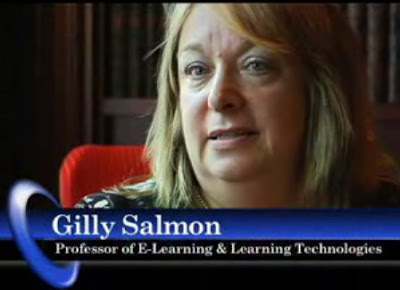
Gilly Salmon, Professor of E-learning & E-learning Technologies at Leicester commented: 'The collaboration between E-learning researchers and Twofour Learning has enabled us to create an environment to explore the myriad of questions that SL raises for learning and teaching in the future. And has provided an examples of a productive collaboration and partnership of two different kinds of organisations working together to create new kinds of student experiences'.
Related links
www.twofour.co.uk/learning
www.le.ac.uk/beyonddistance
www.le.ac.uk/seal
www.le.ac.uk/beyonddistance/mediazoo
University of Leicester- Designing E-Learning
Facilitating an online environment has its own set of characteristics and challenges.
When designing online learning, it's more important to drive it from the learning challenge rather than the technology perspective. You also need to design for student activity rather than delivery of content. Unlike a classroom setting, all the materials need to be prepared and structured in advance.
About Dr Gilly Salmon
Current Position (since October 2004):
Professor of E-learning & Learning Technologies,
*Head of Beyond Distance Research Alliance, University of Leicester, UK
National Teaching Fellow 2006
Role includes:
Development and implementation of e-learning strategy for the University of Leicester, including advice to senior teams and all departments.
Development of sound forward looking student centred pedagogical development for distance and campus based learning.
Establishment and development of the *Beyond Distance Research Alliance including establishing a national and international network of researchers and teachers , securing external research funding, building a research profile.
Establishment of the **’Media Zoo’ – a physical and virtual space for promotion and dissemination of learning technologies across the university and the wider network including Leicester 20 FE partners.
Related links
Gilly Salmon (from Wikipedia, the free encyclopedia)
All Things in Moderation
I'd like to let you know about Pearson's launch of enVisionMATH.
Below are some articles I just read in Chief Learning Officer Magazine (CLO).
E-Learning Is Dead. Long Live E-Learning!
By Sushant Buttan
E-learning has meant many things to many people over the past 15 years. There have been many versions, translations and interpretations, but has it really made an impact on learning effectiveness? From the “shovelware” days of the 1990s, when content was simply shoveled onto the Web and passed off as e-learning, to the current day, when there is an overdose of technology-laden course content, the e-learning industry has left many promises unfulfilled...
The sheer excitement of all the new technology could make one shiver. Catch-phrase abbreviations became the language of communications. If you were a training professional and wanted to be perceived as competent, you needed to know what LMS, LCMS, CMS, WBT, CBT, TBT, VCT, ILT and KMS meant.
Read more...
On Demand: The Googlization of Learning
By John Ambrose
Just a decade or two ago, people thought of learning as a one-way communication, typically held in a classroom setting. Employees would leave their jobs for a while to attend training. Today, of course, most learning organizations realize that instructor-led training is no longer enough. Numerous studies have pointed to the shortcomings of traditional classroom settings for gaining and retaining knowledge.
According to a report by the Research Institute of America, 33 minutes after completion of a live course, students retain only 58 percent of covered information. By the second day, only 33 percent is retained, and by day 30, all but 13 percent of the information covered in the course is lost.
Read more...

Adaptive Curriculum Launches Math and Science Activities
By Dave Nagel
The province of Newfoundland and Labrador in Canada has announced a new initiative that will impact all public education within its borders, from kindergarten to higher ed.
After 31 years in education, Tom retired after six years as a school superintendent in June of 2007 to spend more time with his family. A parent, grandparent, teacher, coach and administrator, Tom stipulates that he truly “relishes the opportunity to share his thoughts on the challenges facing educators and families in today’s complex world.
This study was commissioned by the British Library and Joint Information Systems Committee to identify how the specialist researchers of the future, currently in their school or pre-school years, are likely to access and interact with digital resources in five to ten years’ time. This is to help library and information services to anticipate and react to any new or emerging behaviours in the most effective way. In this report, we define the `Google generation’ as those born after 1993 and explore the world of a cohort of young people with little or no recollection of life before the web.Please be sure to check out the news below.

Due to the rise in popularity of online nursing degree programs, the team at OEDb has created a new site dedicated solely to nursing education at NOEDb.
This unique conference brings together world-class scholars and educators along with business and governmental leaders to formulate a vision for the future of education and the role of technology in that future.
Here are some free eBooks I thought you may find interesting.
eBooks from The eLearning Guild are guaranteed to put a wealth of information at your fingertips!
162 Tips and Tricks for Working with e-Learning Tools
In October and November 2007, The eLearning Guild conducted a survey of its members, asking for their favorite tips for using software to create e-Learning. Members could submit tips in any or all of these five categories: Courseware authoring and e-Learning development tools, rapid e-Learning tools, simulation tools, media tools, and combining and deploying authoring tools.
Published 12-18-2007.
Read more...
The Insider’s Guide to Becoming a Rapid E-Learning Pro
One of the great benefits of rapid e-learning is the ability to create e-learning courses much faster and easier than ever before. However, going faster and making your job easier are not the only considerations. That’s where this free 46-page ebook by Tom Kuhlmann comes in.
Read more...
Guild Research offers research reports of the highest quality, consistency, and utility.
Guild Research reports are designed to give you a complete 360-degree view of each subject. That's why they call them Guild Research 360° Reports. Here is what you'll find in each 360° Report.
This 291 page Guild Research 360° Report includes over 100 pages of survey results that represent the single most comprehensive analysis of how e-Learning professionals use authoring and development tools ever undertaken.
Read more...
Source: The eLearning Guild
http://www.uic.edu/nursing/index.shtml

Cons:
Source: CIPD and TrainingZONE
Since its announcement nearly three years ago, former MIT Media Lab director Nicholas Negroponte’s One Laptop Per Child (OLPC) initiative has generated plenty of controversy. But if the experience of children in Arahuay, Peru, is any indication, skepticism of the program could be short-lived.
It was like one of those ill-fated relationships you suspect won’t last, and on Jan. 3, it finally ended: Citing disagreements with the organization, Intel Corp. said it has abandoned the One Laptop Per Child (OLPC) initiative, dealing a blow to the ambitious project that seeks to bring millions of low-cost laptops to children in developing countries.
In the spring of 2005, I was asked to keynote the EDUCAUSE Western Regional Conference. The conference theme was "Winds of Change: Charting the Course for Technology in Challenging Times." What that brought to my mind was the era of the great sailing ships of the eighteenth and nineteenth centuries, a topic that has always held great interest for me. So as I sail into the sunset, I'd like to update that presentation and offer ten nautical maxims for charting the course of higher education IT in the twenty-first century.
I like the concept of a classroom being on a continuum as a learning community: from opaque, to semi-permeable, to permeable.Source: Techlearning blog
Related link
Helge Scherlund's eLearning News: eLearning, Blended Learning, Computer-Mediated Communication...